

How Many Mega Millions Tickets Were Sold on Friday? We Worked It Out From the Prize Table
Mega Millions doesn’t publish how many plays it sells for each drawing. The prize table gives it away, though, and for Friday the answer is about 6.9 million.
Every drawing ends with a table of winners: how many tickets matched the Mega Ball alone, how many matched three numbers, and so on. Put those counts next to the official odds and you can work backwards to the number of plays.
Here’s how it works for Friday, November 6, when nobody hit the jackpot and it rolled to $529 million for Tuesday.
The method: winners × odds
Every prize tier has fixed odds. Matching the Mega Ball alone, for instance, happens about once every 35 plays. So when 200,677 tickets won that prize on Friday, there must have been roughly 200,677 × 35.17 plays in the drawing: about 7.1 million.
The same sum works for every tier. Tiers with thousands of winners give steady estimates; the rare ones, with a handful of winners, swing a lot from one drawing to the next.
The result for Friday, tier by tier
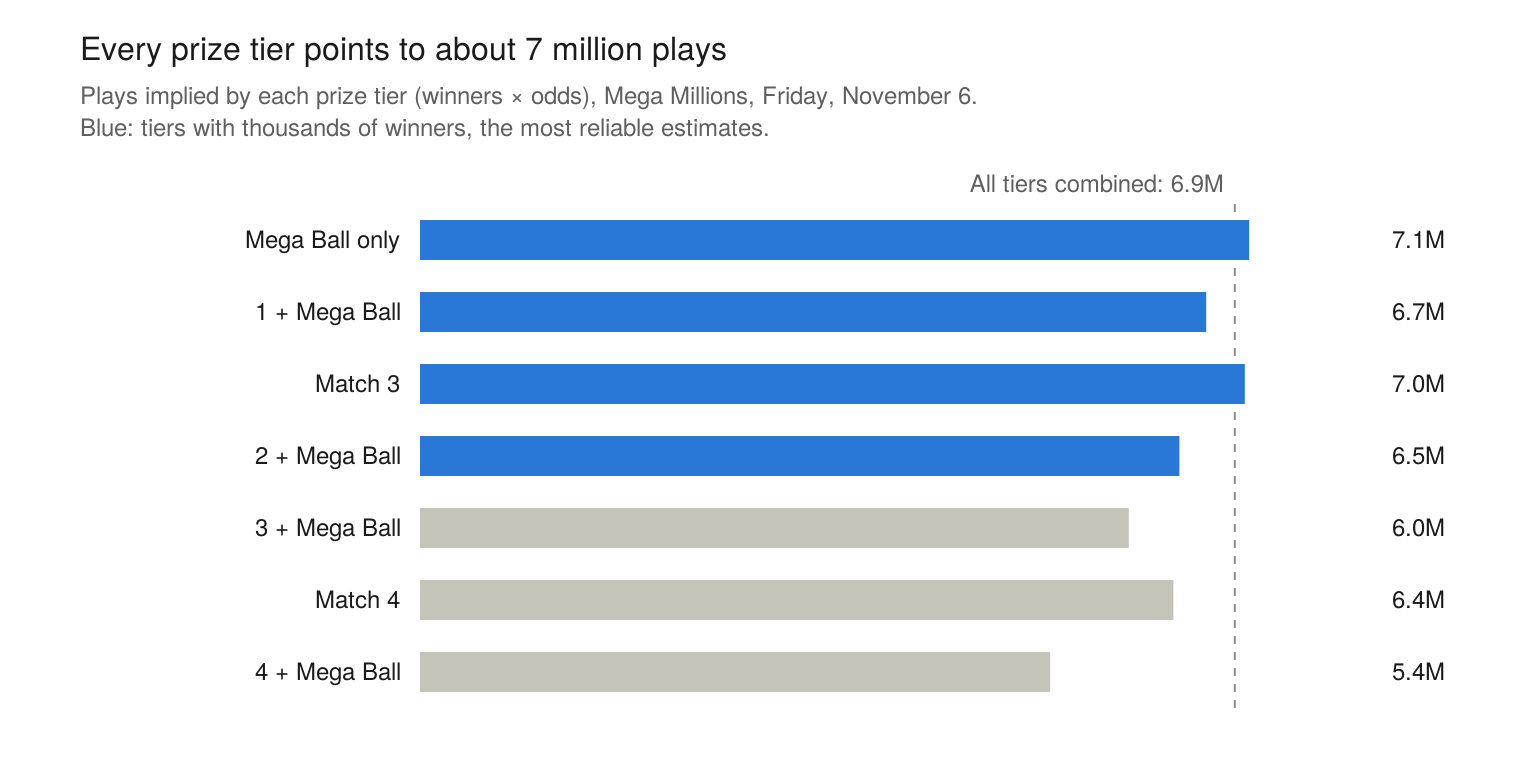
The four tiers with thousands of winners all land between 6.5 and 7.1 million plays. Putting all 300,534 winning tickets together gives the best single estimate: about 6.9 million plays, or roughly $35 million in sales at $5 a play.
What it tells us
Why jackpots roll over so often. With about 6.9 million plays, the chance that any ticket matched all six numbers was only around 2.4%, assuming the numbers were spread at random. That’s a tiny slice of the 290,472,336 possible combinations, and real players cluster on favourite numbers, so the true coverage is a little lower still.
Why the jackpot grows the way it does. The more tickets sold, the faster the jackpot climbs. Since the price rose to $5 in April 2025, Mega Millions sales fell 14.5% between fiscal years 2025 and 2026, while Powerball’s rose 88%, according to LotteryUSA. A $529 million jackpot is exactly the kind of figure that tends to bring players back.
A number to watch. The same calculation can be repeated after every drawing: if the jackpot keeps rolling, the estimate should climb with it.